Posts

Shakespeare

Image
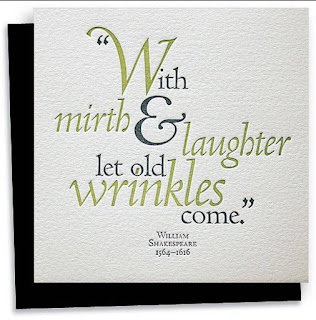
We celebrate William Shakespeare’s birthday on April 23, 1564 (which may or may not be accurate, he was baptized on April 26), he died on April 23, 1616, so it makes the date convenient to remember. He passed at the young age of 52 of unknown causes. Shakespeare was a prodigious writer, perhaps the greatest in the English language, and well-known for his dramatic plays. Scattered throughout his work are his comic insults. Perhaps you would like to try creating a few of your own. The table below will assist you in your attempts. Thank you for joining me today, thou dissembling earth-vexing flap-dragons (much like the SpaceX Starship’s rapid unscheduled disassembly)! And at that, I will leave you with a kinder thought from the playwright himself. Have you read any of Shakespeare’s poems or plays, perhaps during junior high or high school? Here is a list of some of his most famous:  Hamlet ,   Romeo and Juliet ,  Macbeth , and  A Midsummer’s Night Dream .  There ar...

International Haiku Poetry Day

Image
Today haikuists around the world recognize and celebrate their fellow poet’s accomplishments. Writing haiku requires quiet observation, thoughtful consideration, and distillation of a moment into a crystalline nugget. This past weekend I drove to a neighbor’s memorial service. The road that morning was like the occasion, dark and foggy. The experience prompted a haiku inspired by Carl Sandburg’s famous San Francisco fog poem. As I drove, the cat analogy crept around my brain and emerged as the following haiku: Happy Haiku Day to my fellow poets. I hope the non-poets will enjoy this bit of micro poetry, too. You can follow the Author on her  Website  and on  Twitter .

Signs of Spring

Image
I emerge from my convalescence, much as the Earth unfolds from its winter cloak, stretching towards the Sun. I submit some random observances of Spring. Last week a whippoorwill announced his return in evening gloam. The whir of a hummingbird reminds me to retrieve and fill the nectar feeders.  BirdCast Migration tools  will give you an overview of birds on the move over the US continent. You can also hone in on your local area to see what activity to expect. My neglected gardens called out to me today: lavender buried knee-deep in leaves held a hidden surprise. As I approached, the plant shuddered, and autumn leaves crackled. A poke in the pile unearthed an unhappy snake, slithering off, to curl under the dwarf cherry tree, its dark eyes squinting, tongue flickering warning. Nearby, a nuthatch hangs upside down, a cardinal tells me I’m “pretty”, and yellow finches flutter among chickadees, all vying for tasty morsels of suet, seeds, and fruit. A  dove splashes in the bir...

Palm Sunday

Image
Christians celebrate Palm Sunday on the Sunday preceding Easter Sunday. This occasion was my inspiration for a haiku using the concept of yügen. A haiku can be written to demonstrate yügen, “cloudy impenetrability,” mystery. The definition by Robert D. Wilson: yügen is like the echo after the clang of a brass bell. palm branches raising psalms on the zephyr   [by JL Huffman] Thank you to Patrica McGuire of Poetry Pea for the educational podcast,  Yügen for your Haiku Toolbox  [ S4EE11 ] demonstrating the concept of yügen. In addition, my thanks to Patricia for choosing the above haiku for podcast [ S4E16 ]  Original Haiku using Yügen  and for inclusion in the  Poetry Pea Journal: Summer 2021 . Is there something profound in your life? Try writing a poem or story or creating another art form to portray this intense sensation. You can follow the Author on her  Website  or on  Twitter .  

Inspiration

Image
Today I sat down at my laptop and wondered what to share with you, my readers. A glance out of the open door showed trees tossing. Wind chimes sounded in the background, the breeze nuzzled my skin, and the scent of early alyssum teased my nose. Once again, nature nudged me. Taking a moment to pause and experience our surroundings can enrich our hearts and minds. But did I just give you a rote description of my view? Authors and artists see and feel the situation before them and translate those sensations into their creative medium. A poem, a painting, a sculpture, or a song attempt to elucidate an extension of those feelings in the individual that looks at or listens to the art form. Writing and other arts are labors in observation, rendering, and transformation. A light bulb moment can be quickly reproduced or take hours, days, or even years to realize a satisfactory final product. Perseverance is requisite. Are you a creative individual? What sparks your work? You can follow the Auth...

March Madness

Image
The term  march madness  conjures up visions of basketball and brackets.  In fact, as I write, NCAA Women’s basketball drones in the background. As a gardener, I imagine a different sort of insanity, wild weather swings that endanger new growth. Weeks of 60-degree warmth enticed forsythia, spring bulbs, and flowering trees into bloom. Grass greening, worms, and mud. As we basked in their beauty, a nasty cold snap with fifty-mph winds brought us back to reality. Tree limbs sagging, bowed under ice, fruit tree blossoms brown, dead, and withered daffodils. Fruit harvest threatened. Winter getting in her last licks. Have you seen weather fluctuations in your region? Did you have enough warning to cover and protect your plants?  You can follow the Author on her  Website  or on  Twitter.

π (pi) Day

Image
In 1988, the holiday  π  (pi) Day was founded by Larry Shaw, a physicist at the Exploratorium California Science Museum, to observe the mathematical constant pi ( π ). March 14 (3/14) was chosen because the first three significant figures of  π  are 3, 1, and 4. The United States House of Representatives passed a non-binding resolution recognizing  π  (pi) Day in 2009. Super Pi Day was celebrated in 2015 on 3/14/15 at 9:26:53 to represent the first 10 digits of  π . What is  π ? It is the ratio of the circumference of a circle to its diameter. It is an irrational number (not equal to the ratio of any two whole numbers.) π , or its approximation, was described by the ancients. The  Babylonians  (c. 2000 BCE) obtained the value 3.125 by calculating the perimeter of a hexagon inscribed within a circle. The  Rhind papyrus  (c. 1650 BCE) scribed by the Egyptians used the value ~ 3.16045, and more recently,  Archimedes  (c....